
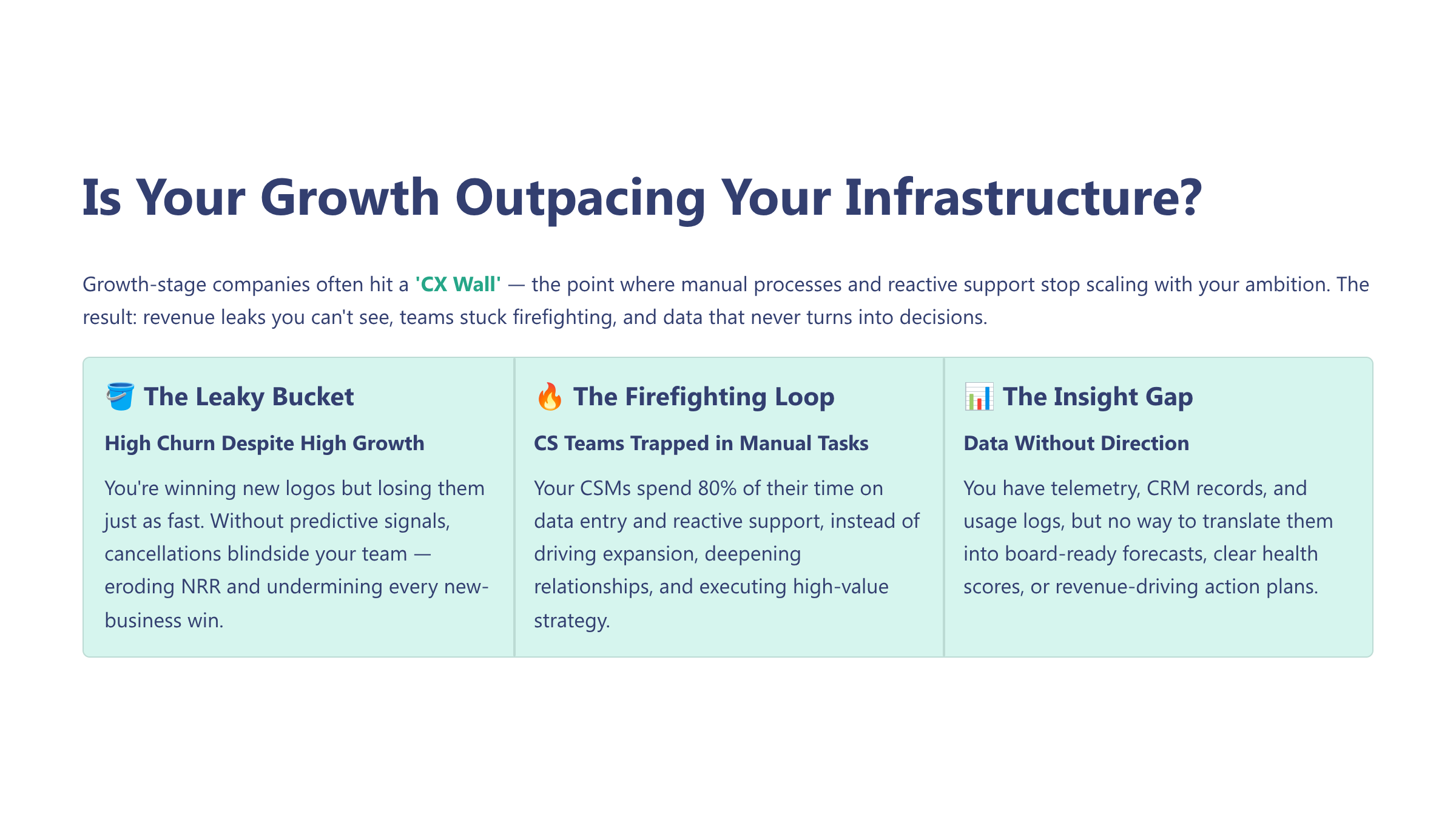
In the fast-paced world of Software as a Service (SaaS), founders often experience euphoria during the early stages of growth when acquiring new customers feels like a straightforward endeavor. However, as they transition to mid-market scaling, many quickly encounter a perilous challenge: the 'CX Wall.' This metaphor encapsulates the struggle many SaaS leaders face as the silent churn of existing customers begins to drain the vitality from their business, undermining efforts to drive retention and long-term value. No matter how many new logos are won, an ineffective customer experience can prevent sustainable growth, leading to a leaky bucket scenario where customer losses outweigh new acquisitions.
To navigate these turbulent waters, SaaS founders must break free from the firefighting loop often created by manual customer success processes. These reactive strategies can consume valuable time and resources, leaving little room for proactive engagement, expansion efforts, and the development of a robust CX strategy. Coupled with a pervasive data-to-insight gap, where ample customer telemetry fails to convert into actionable intelligence, the result can be detrimental to net revenue retention (NRR). Fortunately, by leveraging AI in customer success, companies can implement predictive health modeling and automated opportunity signals, turning their customer success functions into a profit center rather than a cost center. In this blog post, we will delve into these challenges and the solutions that will help SaaS founders scale their operations effectively while preserving customer satisfaction and loyalty.
Understanding the leaky bucket problem: The impact of silent churn on SaaS retention
As SaaS founders transition from early-stage growth to mid-market scaling, the focus often shifts to acquiring new customers. However, this strategic pivot can inadvertently blind them to a far more pressing issue: silent churn. This insidious phenomenon occurs when engaged customers gradually reduce their usage or fail to renew, bleeding the company’s revenue without any obvious signs. While new logos boost the top line, they can’t compensate for the lost revenue from churned accounts. To put it simply, a leaky bucket can only hold so much water before it becomes an unsustainable model, threatening the very foundation of your growth strategy.
This silent churn not only impacts SaaS retention rates but also stifles net revenue retention (NRR). Founders often find themselves puzzled by the paradox of high customer acquisition rates coexisting with stagnant or declining revenue numbers. Ignoring silent churn can create a false sense of progress, leading to decisions based on inflated metrics instead of the underlying reality. By addressing the leaky bucket early, SaaS founders can prioritize customer engagement and retention strategies that align with long-term growth objectives, ensuring that every new account contributes positively to the bottom line.
Breaking the firefighting loop: How manual processes hinder scalability in customer success
Manual processes in Customer Success can create a detrimental firefighting loop, where teams are constantly responding to urgent issues rather than strategizing for long-term growth. As SaaS companies scale, the influx of customers means that success teams often find themselves overwhelmed with reactive tasks such as troubleshooting, responding to tickets, and other day-to-day firefights. This focus on managing crises prevents teams from concentrating on proactive initiatives that drive expansion and enhance customer relationships. Founders and Customer Success leaders may find that the time spent extinguishing small fires detracts from their ability to foster an environment of sustained customer engagement and loyalty.
Furthermore, reliance on manual processes limits the scalability of customer success initiatives. As teams juggle multiple responsibilities, they inadvertently prioritize operational tasks over strategic planning for customer retention and net revenue retention (NRR). This reactive approach becomes a barrier to growth, as insights derived from day-to-day interactions get lost in the chaos. The inability to streamline operations hampers effective communication, forecasting, and customer engagement, ultimately leading to missed opportunities for upselling and expansion. Founders must recognize that inefficient workflows do not just hinder performance; they can jeopardize the sustainability of the entire business.
Bridging the data-to-insight gap: Leveraging AI for actionable intelligence in customer success strategies
SaaS founders often invest heavily in customer telemetry, gathering data on user behavior, product usage, and engagement. However, this wealth of information can become a double-edged sword without a clear strategy for translating data into actionable insights. Many Customer Success teams find themselves overwhelmed with raw data, struggling to identify the patterns and signals that indicate customer health. This frustration is further compounded when presenting insights to the board; presenting a sea of numbers without context or predictive power leads to stagnant conversations about growth, instead of actionable strategies to enhance SaaS retention and Net Revenue Retention (NRR).
Artificial Intelligence offers a robust solution to this data-to-insight dilemma. By employing AI-driven predictive health modeling, Customer Success teams can convert massive troves of customer data into tailored insights that boost customer engagement while also identifying potential churn risks earlier than traditional methods. Moreover, automated 'Opportunity Signals' can alert teams to expansion opportunities, guiding proactive engagement efforts. This not only improves customer satisfaction but also aligns seamlessly with a forward-thinking CX strategy for founders. By effectively bridging this gap, SaaS businesses can elevate their Customer Success initiatives from reactive firefighting to strategic growth catalysts, significantly improving retention metrics and driving profitability at scale.
Stay updated on our news and events! Sign up to receive our newsletter.
Thank you for signing up!
Something went wrong. Please try again later.